*The information provided in this blog is general in nature and should not be considered medical advice. Individual conditions vary, and proper evaluation is important. To receive accurate diagnosis and treatment, we encourage you to book an appointment with our experienced medical team.
Peyronie’s Disease Treatment: 7 Effective Options for Penile Curvature
What Is Peyronie’s Disease?
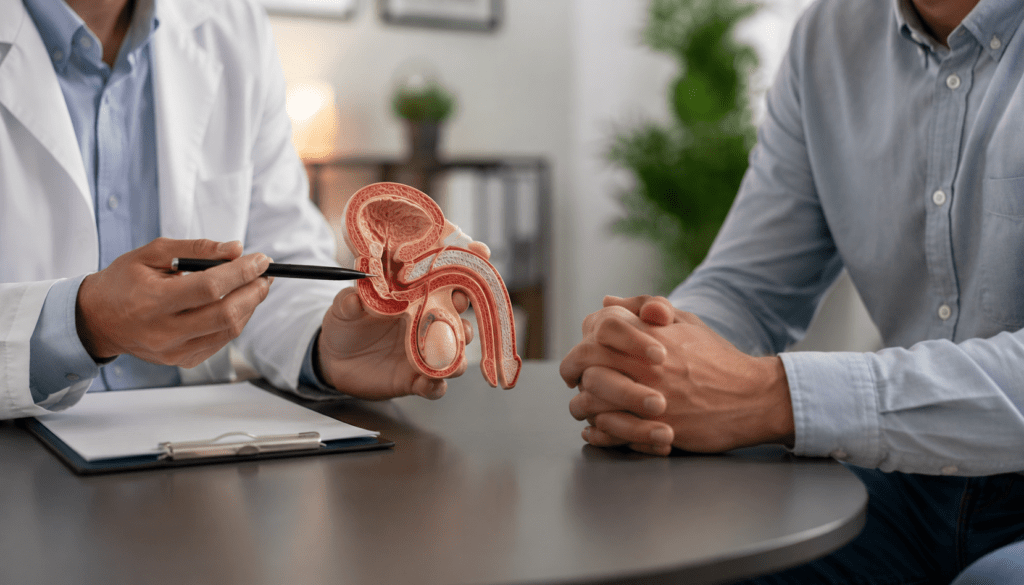
Scar tissue, also called plaque, forms under the skin of the penis, leading to Peyronie’s disease. The buildup is typically inside the tunica albuginea, a thick elastic membrane that helps the penis stay stiff and erect. While the plaque can develop anywhere along the penis, it pulls on the surrounding tissues, resulting in a penile curvature usually during erection. Sexual intercourse can become difficult or, sometimes, impossible because the curves in the penis make erections painful.
Plaque Development Phases
Plaque can develop due to injury to your penis. Autoimmune diseases can also lead to plaque formation. This is not to be confused with the plaque that forms in the arteries. A plaque formed in Peyronie’s disease is non-cancerous and benign. The disease primarily occurs in two phases: Acute and Chronic (Stable).
1. Acute Phase
The acute phase can last for around 18 months. During this phase, inflammation forms under the skin, and the penis begins to curve. The organ may hurt even without an erection. Thereafter, erections become painful too, when the scar tissue develops.
2. Chronic or Stable phase
Typically, starting 12 to 18 months after your first symptoms appear, the penile curvature stabilizes (that’s why it’s called the Stable Phase), and plaque formation does not worsen. The pain in the penis may lessen. However, erectile dysfunction could develop. If your symptoms have not changed for around three months, healthcare professionals consider Peyronie’s disease stable. Generally, patients are administered injections as a treatment modality. The area of the plaque is first numbed, and then a medication is injected.
Medication options include:
- Verapamil to reduce pain and curvature.
- Interferon-alpha 2b to reduce curvature, pain and the size of the plaques
- CCH to reduce curvature, improve erectile function and break up plaques
Once the curvature appears stable for about 3 to 6 months and a year has passed since the symptoms first appeared, your doctor may recommend treating Peyronie’s disease with surgery. Suggestions depend on the impact of the disease on your erection and on your curvature.
Must Read: Myths about erectile dysfunction and men’s health
Peyronie’s Disease Treatment Options
Several effective treatments are available for Peyronie’s disease. Management strategies include oral medications, surgical interventions and penile stretching devices. All are meant to reduce pain and curvature and slow plaque formation. The healthcare professional first checks the stage of the disease, whether stable or active inflammatory and only then administers the treatment.
Here are seven options to treat penile curvature and Peyronie’s disease:
1. Penile Traction Therapy (PTT)
For a preset period each day, traction devices apply mechanical stretching to the organ. This is administered during the early stages of the disease so that the penis can regain its lost strength. Surgery and injections may also be administered alongside PTT.
2. Collagenase Injections
An intralesional enzyme called Xiaflex is injected into the scar tissue directly to break it down. This improves sexual function and reduces curvature. The treatment is typically combined with gentle stretching of the penis or penile modelling.
3. Interferon-Alpha Injections
A naturally occurring protein, this is injected directly into the plaque. The administration is similar to collagenase. Studies have shown that the remedy is highly effective in reducing plaque size and penile pain. It is considered the go-to treatment for those experiencing active inflammation.
4. Oral Medications
Oral pills are generally given to reduce painful plaque buildup or slow down scar tissue formation. These are prescribed off-label and do not effectively cure a severe curve. Pentoxifylline or potassium aminobenzoate (Potaba) is prescribed to break up plaque and enhance blood flow.
5. Penile Plication
A minimally invasive surgery, it is done when the stable curvature is severe and interferes with intercourse. Internal sutures are placed on the longer side of the penis to straighten it. While the plication technique is highly effective, it can lead to a minor loss of penile length.
6. Penile Implants
The procedure is meant for patients who experience moderate-to-severe erectile dysfunction that accompanies penile curvature. A semi-rigid, inflatable prosthetic is implanted that models the penis to straighten the shaft and break the scar tissue.
7. Vacuum Erection Devices
Vacuum Erection Devices, or VEDs, are non-invasive physical therapy devices that act by creating a vacuum and pulling blood into the penis to expand it. This is a supportive mechanism for tissue remodelling that helps reduce curvature and preserve organ length when administered alongside traction.
Non-surgical Peyronie’s disease treatment at Urogen ED Burlington
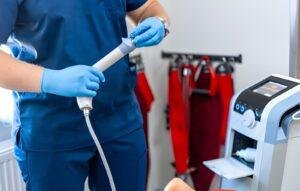
A natural and surgery-free option, Urogen ED Burlington brings the effective Wave Therapy to improve the roots of the disease rather than simply treating the symptoms. Wave Therapy is not a temporary fix. Rather, it is a long-term pathway to strength, performance and confidence. Using gentle acoustic waves, patients can achieve longer-lasting erections with improved blood circulation in the penis.
Speak to medical professionals at Urogen ED Burlington today.
FAQs
Plaque develops as a result of an injury to the penis or an autoimmune disease. These plaques are benign and non-cancerous.
Ideally, they do not cure curvatures, but they can slow down scar tissue formation and minimize painful plaque buildup.
During the early stages of Peyronie’s disease, PTT is administered for a set period each day. The mechanical stretching of the organ so that the penis regains its lost length.
VEDs are Vacuum Erection Devices that are effective in pulling blood into the penis to expand it.
Many men have reported long-lasting results with our Wave Therapy. Check with our medical professionals today.
Medical Disclaimer: This blog is provided for informational and educational purposes only and should not be considered medical advice, diagnosis, or treatment recommendations. The content represents general information about benign prostatic hyperplasia and related conditions based on medical knowledge and clinical experience, but every patient’s situation is unique. Prostate conditions can be serious and require proper medical evaluation and treatment. Do not use this information to self-diagnose or self-treat.
Always consult with a qualified healthcare provider, preferably a urologist, for proper evaluation, diagnosis, and treatment recommendations specific to your individual health situation. Treatment options, risks, benefits, and outcomes vary significantly between patients based on age, overall health, prostate size, symptom severity, and other medical conditions.
Medications mentioned carry specific risks and side effects that must be discussed with your doctor. Delaying proper medical care for prostate conditions can lead to serious complications, including kidney damage, bladder damage, urinary retention, and other health problems. If you experience inability to urinate, blood in urine, severe pain, or other urgent symptoms, seek immediate medical attention. This content does not create a doctor-patient relationship.